Kogama Platform Run Challenge succeeds by keeping its focus tight. The controls are crisp, the courses are thoughtfully designed, and the variety of mini-games prevents repetition from setting in. It is a game that respects the player's time: each attempt teaches something new, and failure is simply an invitation to try again. The bright visuals and calm audio create a stress-free environment, making it easy to concentrate on the task at hand. For anyone looking for a straightforward, family-friendly platforming experience that emphasizes skill over luck, this is a solid choice.
Each obstacle course in Kogama Platform Run Challenge is built around a central idea: test the player's ability to judge distances and time their actions. The layouts are not random but carefully arranged to create a rhythm of jumps, pauses, and quick movements. Some courses emphasize long gaps between platforms, while others focus on tight spaces where every step matters. This variety keeps the experience fresh and encourages players to approach each section with a fresh perspective.
The game uses simple keyboard inputs for movement and jumping. Arrow keys or WASD handle direction, and the spacebar triggers jumps. What makes the controls effective is their immediate response to player commands. There is no noticeable lag, so the character moves exactly as instructed. This precision is essential when navigating courses that require split-second decisions. The simple control scheme lowers the entry barrier, allowing new players to focus on the course itself rather than complex button combinations.
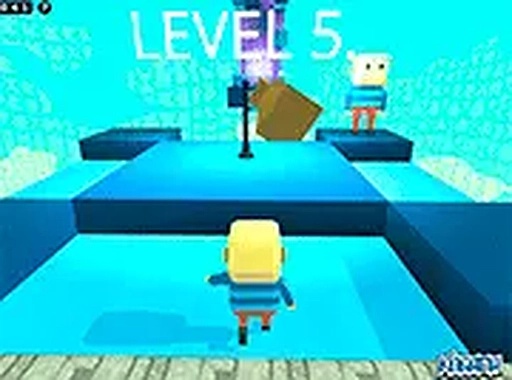
From the main map, players can access multiple mini-games via teleport points. Each mini-game presents a distinct set of obstacles and a different visual theme. One might feature floating platforms above a colorful void, while another uses moving walls and rotating beams. This structure prevents monotony and gives players reasons to return and try something new. The mini-games are not just cosmetic changes; they introduce different movement patterns and timing requirements, ensuring that skills learned in one area are tested in new ways elsewhere.
Progress in Kogama Platform Run Challenge comes from repeated attempts and learning from mistakes. Each course can be replayed as many times as needed, and the game does not punish failure harshly. Instead, it encourages players to observe obstacle patterns and adjust their approach. Over time, players develop a mental map of each course, leading to smoother runs and faster completions. This gradual mastery is satisfying and aligns well with the game's focus on skill development through practice.
The visual style is bright and clean, with distinct color palettes for different mini-games. The environments are not cluttered, which helps players focus on the obstacles. Background music is light and unobtrusive, providing a steady rhythm without becoming distracting. Sound effects for jumps and landings are crisp, giving clear audio feedback that complements the visual cues. This combination creates a calm yet focused atmosphere, ideal for concentration-based gameplay.





Player Comments
Sign in to comment
You must be logged in before posting a review or rating.
No account? Create one
No comments yet. Be the first to comment!